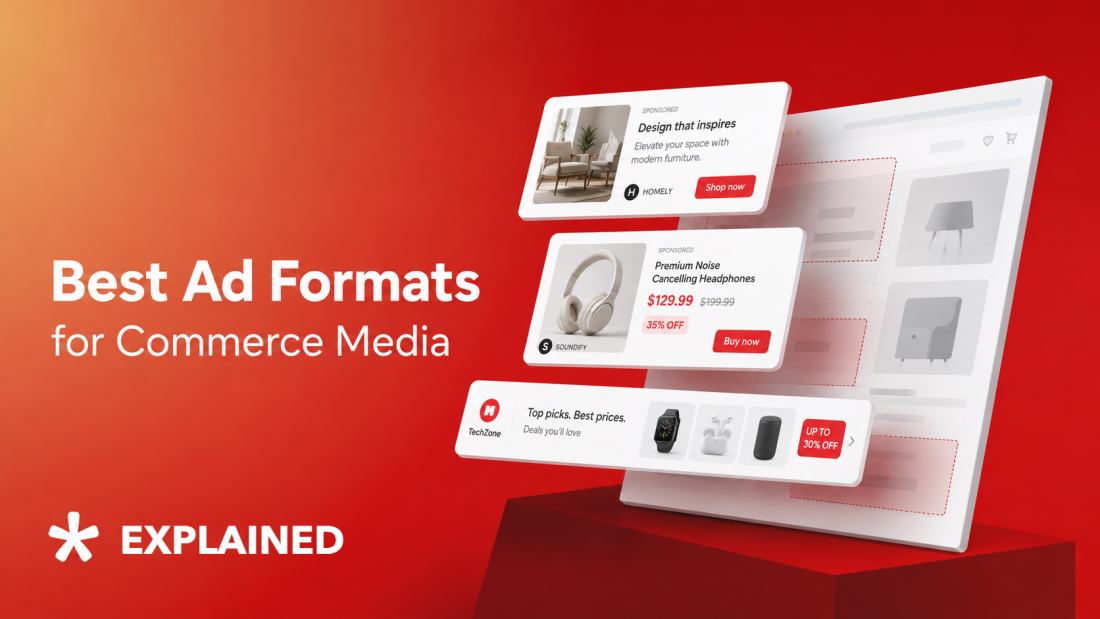
Best ad formats for commerce media: extending monetization beyond traditional banners
For a commercial media network, ad formats are not merely creative templates. They determine which inventory can be monetized, which advertiser budgets can be captured, how relevant advertising feels to users, and how effectively campaigns can be measured.
The right creative format portfolio enables the commerce media owner to monetize the entire customer journey: from awareness and product discovery to conversion, loyalty activation, and repeat purchase. It also makes it possible to use website, app, digital screens, customer data, and offsite programmatic reach as one connected media ecosystem.
- What Advertisers Expect from Ad Formats
- What Commerce Media Owners Expect from Ad Formats
- A Unified Creative Portfolio for Commerce Media Monetization
- Native-to-Display: scalable brand and performance campaigns
- Universal Native: monetizing every owned environment
- Product Banners: feed-driven performance and remarketing
- How the Ad Formats Work Together
- How Admixer Creative Studio Can Help Commerce Media Maximize Monetization
What Advertisers Expect from Ad Formats
Advertisers need formats that are operationally simple, commercially accountable, and suitable for their specific objective.
1. Minimal creative-production burden
Advertisers should be able to launch campaigns using a limited set of assets rather than designing separate materials for every banner size, app module, screen, and external placement.
2. Adaptability across channels
A campaign should be able to move from onsite display to app placements, digital screens, and offsite programmatic inventory without rebuilding the creative concept from scratch.
3. Relevance and personalization
Advertisers expect the ability to show the right product, offer, or message based on audience characteristics, browsing context, past purchases, location, and remarketing signals.
4. Product and promotion flexibility
For commerce-led campaigns, advertisers need to display product feeds, prices, discounts, product availability, bundles, loyalty rewards, and other commercial messages dynamically.
5. Measurable business outcomes
Formats should connect to clear KPIs: reach, engagement, product views, clicks, add-to-cart actions, purchases, repeat purchases, offer redemption, return on ad spend, and incremental sales.
6. Brand control and creative quality
Even in dynamic and native environments, advertisers need control over logos, messaging, product presentation, CTA, landing pages, and the contexts in which their ads appear.
7. Flexible buying models
Advertisers should be able to choose the commercial model that matches the campaign objective: CPM for awareness, CPC for traffic, CPA or CPO for sales, and fixed-fee sponsorship for premium ownership.
What Commerce Media Owners Expect from Ad Formats
For the resource owner, the format portfolio must meet several operational and commercial requirements.
1. Coverage across all owned environments
Formats should be able to run across website, app, digital screens, loyalty environments, and, where relevant, offsite channels. The objective is to avoid having isolated inventory pools with separate products, creative processes, and sales packages.
2. Native integration without sacrificing monetization
Advertising must adapt to the visual logic of each environment. Formats should support responsive sizes, custom layouts, brand-safe presentation, and sufficient flexibility to display product, price, discount, availability, loyalty, or promotional information.
3. Scalable creative operations
The commercial media owner should not need to produce or manually adapt dozens of creatives for every campaign. A small set of structured assets should be sufficient to generate multiple versions across placements and channels.
4. Strong targeting and decisioning
Formats must work with audience, contextual, behavioral, geographic, store-level, and remarketing signals. This is essential for increasing advertiser performance while maintaining relevance for users.
5. Support for feed-driven campaigns
Commercial media owners need formats that can use live or regularly updated product data. Product availability, pricing, promotions, margin, category, and campaign priorities should influence which products are shown.
6. Commercial flexibility
The format set should support both auction-based and reserved campaigns. This allows the owner to monetize lower-funnel demand through CPC or CPA models while selling premium visibility through CPM, sponsorship, fixed-fee, and share-of-voice packages.
7. Offsite activation capability
Where consent and data governance allow, the same formats should support programmatic offsite activation. This expands advertiser reach and enables the owner to monetize
A Unified Creative Portfolio for Commerce Media Monetization
A well-designed format portfolio therefore creates value for both sides of the marketplace: the commercial media owner gains more monetizable inventory and revenue models, while advertisers gain scalable reach, relevance, performance, and transparent measurement.
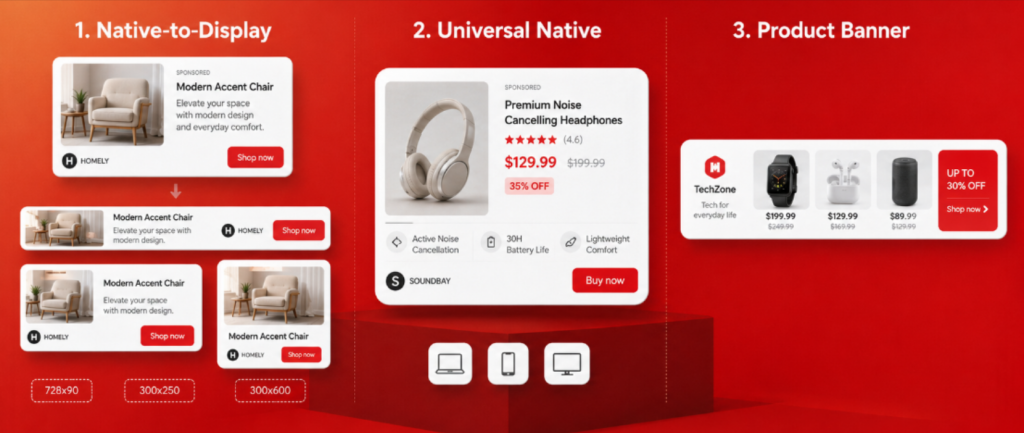
The combination of Native-to-Display, Universal Native, and Product Banners gives a commercial media network a flexible creative foundation for monetizing website, app, digital-screen, and offsite inventory without requiring advertisers to build separate campaigns for every channel or placement.
Each format addresses a different commercial use case while relying on shared campaign assets, targeting logic, and measurement.
Native-to-Display: scalable brand and performance campaigns
Native-to-Display is the most versatile format for campaigns that need to run across multiple display environments. Advertisers upload one asset set — headline, description, image or video, brand link, and CTA – and the platform automatically adapts it into standard and custom banner sizes.
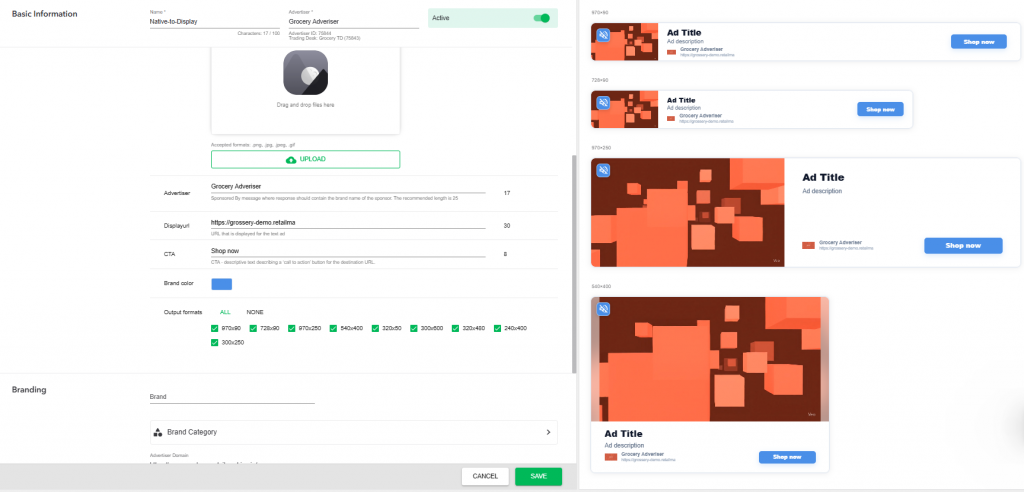
This makes the format particularly valuable for:
- brand awareness and product-launch campaigns;
- promotional campaigns across multiple website and app placements;
- video-led campaigns that require broader reach;
- offsite programmatic activation using the same campaign assets;
- audience and contextual targeting across owned and external inventory.
For the media owner, Native-to-Display increases fill potential across diverse placements while preserving visual consistency and reducing creative-production friction. It enables advertisers to launch broader campaigns faster, which is particularly important for short-term promotions, seasonal activity, and always-on media budgets.
Universal Native: monetizing every owned environment
Universal Native is the core format for highly integrated commercial placements. Its flexible field structure makes it possible to display not only brand and product messaging, but also price, discount, original price, loyalty benefit, delivery condition, availability, bonus points, or other commerce-specific information.
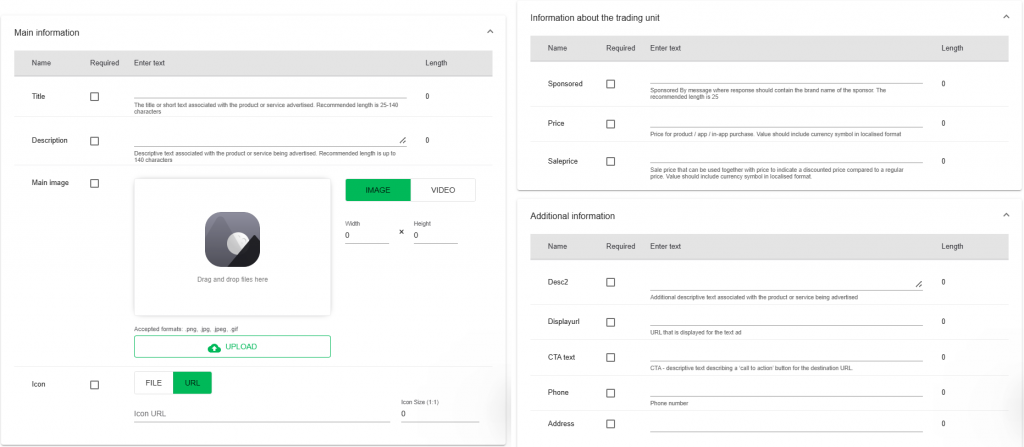
Because the format can adapt to website modules, app feeds, recommendation surfaces, and digital screens, it helps turn virtually any owned environment into monetizable inventory without making it look like a conventional banner placement.
It is especially effective for:
- sponsored product and promotional modules;
- personalized offers and loyalty campaigns;
- category recommendations and deal feeds;
- in-app commerce placements;
- in-store screen campaigns;
- local or store-specific promotions;
- programmatic offsite native advertising.
For advertisers, Universal Native provides a more relevant and commerce-oriented presentation. For the commercial media owner, it creates a scalable way to sell native placements across the full ecosystem while preserving user experience and supporting audience, contextual, and location-based targeting.
Product Banners: feed-driven performance and remarketing
Product Banners are designed for advertisers that need to promote multiple SKUs, collections, or dynamically selected products. They combine a brand identity with products from a feed and can populate each banner according to commercial rules, product availability, category relevance, best-seller logic, price changes, or remarketing signals.
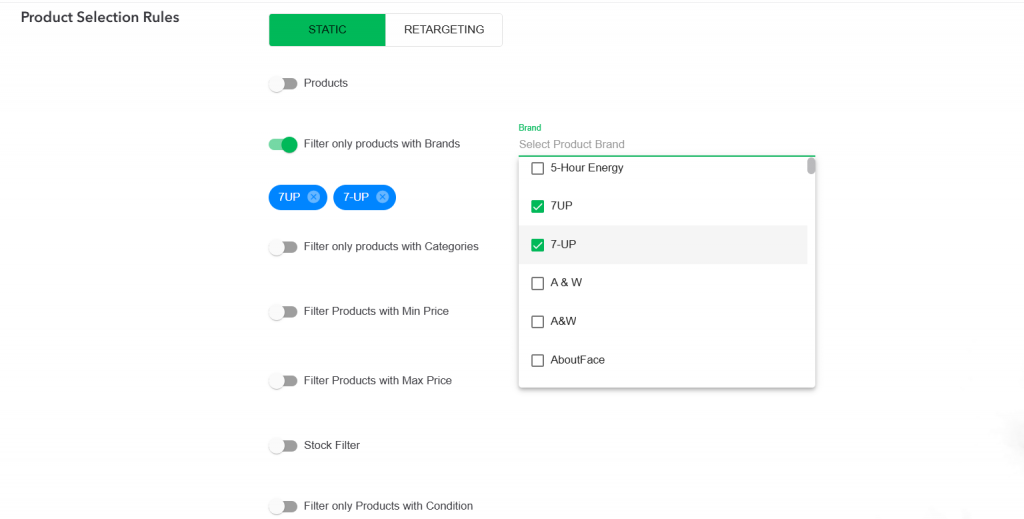
This makes Product Banners particularly suitable for:
- promoting relevant products based on browsing or purchase history;
- cross-sell and upsell campaigns;
- seasonal collections and promotional assortments;
- price-led or availability-led campaigns;
- retargeting users who viewed but did not purchase products;
- offsite dynamic advertising;
- marketplace sellers and brands with large catalogs.
For the media owner, Product Banners create a strong performance product that can be sold on CPM, CPC or CPA-oriented models. They also allow inventory to be monetized with more relevant ads, since the products shown can change dynamically according to the user, context, placement, or campaign rules.
How the Ad Formats Work Together
Together, these formats create a complete creative system rather than three disconnected ad products.
Native-to-Display provides broad reach and campaign scalability. It is best used when a brand needs to distribute one message across many display placements, including offsite programmatic inventory.
Universal Native enables deeper monetization of owned environments. It turns website modules, app interfaces, loyalty surfaces, and digital screens into native commercial placements that can display richer product and promotional information.
Product Banners provide the lower-funnel performance layer. They use live feed data, behavioral signals, and remarketing logic to convert product interest into measurable sales.
This combination allows a commercial media network to support the full advertiser journey:
- Awareness: video, rich visual assets, and broad Native-to-Display distribution;
- Consideration: native promotional modules, branded offers, and contextual placements;
- Conversion: product-feed banners, dynamic product recommendations, and remarketing;
- Retention: loyalty-led Universal Native offers, personalized promotions, and repeat-purchase campaigns;
- Offsite reach: programmatic activation using native, display, and dynamic product creative formats.
As a result, the network can monetize not only traditional banner inventory, but also product-discovery surfaces, loyalty interactions, personalized feeds, app experiences, digital screens, and external media channels – while giving advertisers one operationally simple campaign framework.
How Admixer Creative Studio Can Help Commerce Media Maximize Monetization
Admixer Creative Studio is a creative management module integrated into Admixer products (DSP, Ad Platform, Retail Media Platform). It contains over 40 creative templates for all advertising environments: websites, apps, CTV, DOOH, In-Store Video and Audio.
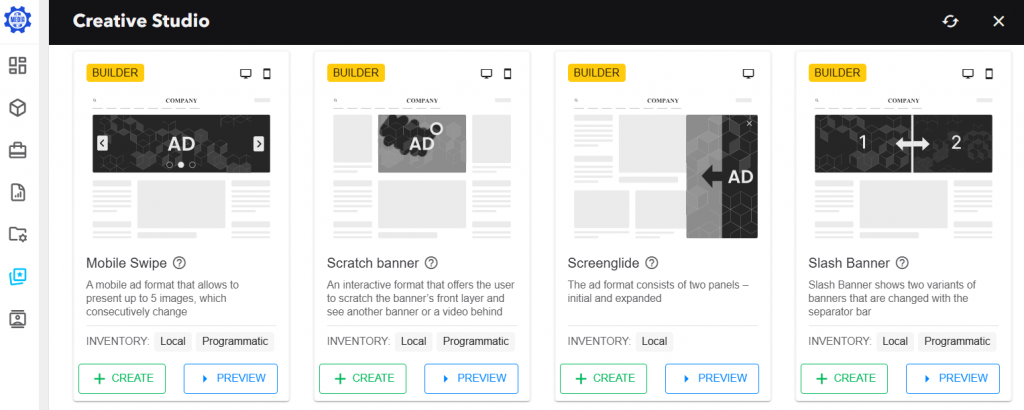
The templates allow advertisers and media owners to quickly create the necessary creatives for advertising campaigns without additional programming, configure them for use in campaigns across all channels, and obtain comprehensive statistics on their use.
In addition to standard banner, video, and audio ad formats, there is a range of native and product formats that covers all advertiser needs, whether it’s performance or availability advertising. Native format templates can be customized to suit the design and requirements of media resources.
The main advantages of Admixer Creative Studio are:
- quick company launch
- minimal resources and qualifications required for launch
- formats accepted across all advertising channels
- creative analytics and optimization
Want to try Admixer’s creative solution for monetizing your projects? Register for a demo and get a free trial.
Looking for comprehensive monetization of commercial or retail media? Try Retail Media Machine ad platform for managing ads across onsite, offsite, and in-store resources.
Contact us for more information and demo.